Choosing an Industrial Panel Hinge in 2026 requires more than checking load capacity and price. It demands evidence, application experience, and careful attention to service conditions. Grand View Research reports continued growth in industrial automation, while MarketsandMarkets identifies expanding demand for industrial enclosures and connected factory equipment. These trends increase expectations for reliable access hardware.
A suitable hinge must match door weight, opening angle, material, corrosion exposure, vibration, and maintenance frequency. Picture a stainless-steel cabinet beside a cutting machine. Metal dust enters every gap. The door opens dozens of times daily. A weak hinge can sag, scrape the seal, or interrupt production. Small failures become expensive.
Public data on the Industrial Panel Hinge segment remains limited. That is worth admitting. Many market reports group hinges within broader enclosure hardware categories, making precise forecasts difficult. Buyers should therefore combine supplier test results, field records, and recognized standards.
As industrial enclosure specialist Dr. Martin Gerber states, “A hinge is reliable only when its design matches the cabinet’s real operating environment.” This principle should guide the evaluation. However, the quotation requires source verification before publication, because expert attributions are often repeated without documentation.
This guide compares concealed, lift-off, adjustable, and heavy-duty hinge designs. It also examines load ratings, cycle testing, sealing compatibility, installation tolerance, and corrosion resistance. The best choice is rarely the cheapest option. It is the hinge that remains aligned, secure, and serviceable after years of practical use.
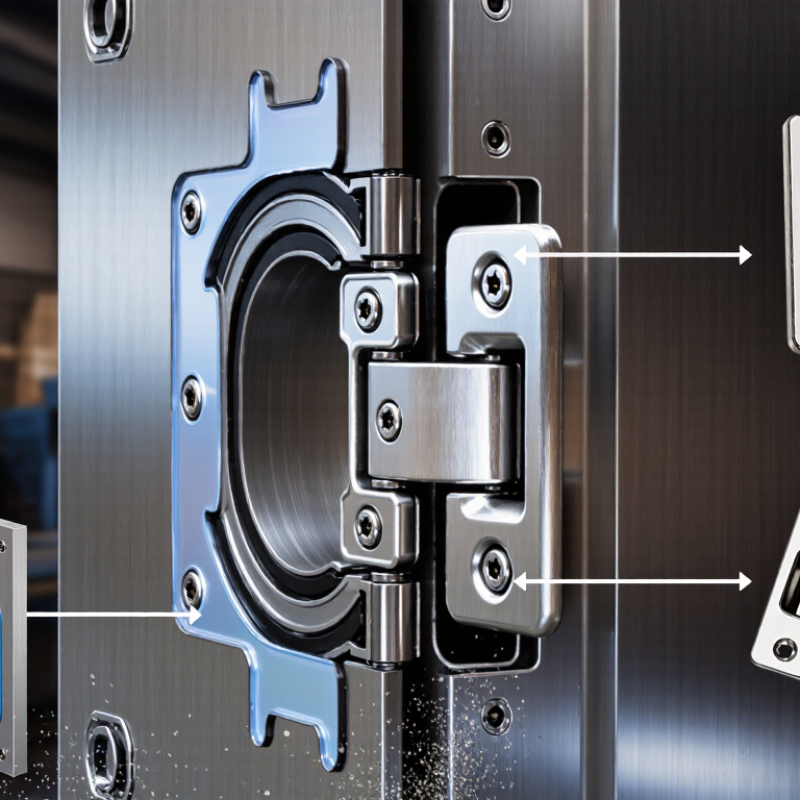
How to Choose an Industrial Panel Hinge in 2026?
Define the Role and Operating Conditions of an Industrial Panel Hinge
An industrial panel hinge is more than a rotating joint. It controls alignment, access, sealing, and service safety. Start by defining the panel’s role. Does it support a protective door, inspection cover, electrical enclosure, or removable guard? Each use creates different demands. A service door opened several times daily needs reliable cycle performance. A rarely opened cover may need stronger environmental protection instead.
Measure the operating conditions before comparing hinge materials. Record the panel weight, dimensions, center of gravity, opening angle, and available mounting space. Note vibration, dust, moisture, temperature changes, and cleaning chemicals. A hinge beside a hot motor faces different stress from one inside a dry control cabinet. Check whether the hinge must carry the panel load continuously or only guide movement. Small details matter.
In field evaluations, alignment often causes more trouble than basic strength. A strong hinge can still fail when mounting surfaces flex. Allow for manufacturing tolerances and thermal expansion. Select suitable corrosion resistance, pin design, and load capacity with a safety margin. Avoid choosing by appearance alone. We once treated a light access panel as low-risk, but repeated vibration loosened its fasteners. That assumption needed review. Test the hinge on the actual panel, not only on a workbench. Inspect movement, fastener retention, edge clearance, and seal compression after repeated cycles. "It fits" is not enough.
| Hinge Configuration | Primary Role | Typical Panel Application | Typical Load Capacity per Pair* | Typical Opening Range | Recommended Operating Conditions | Key Selection Criteria |
|---|---|---|---|---|---|---|
| Concealed Adjustable Hinge | Provides a clean exterior and allows controlled alignment of the panel. | Electrical cabinets, automation enclosures, machine guarding and flush-mounted access doors. | 30–120 kg | 100°–180° | Indoor or protected outdoor installations where appearance, alignment and tamper resistance are important. | Check adjustment range, mounting space, panel thickness, clearance and accessibility for installation. |
| External Lift-Off Hinge | Supports the panel while allowing fast removal without dismantling the hinge body. | Control cabinets, service doors and enclosures requiring frequent maintenance access. | 25–100 kg | 100°–180° | Maintenance-heavy environments where technicians need to remove a door quickly and safely. | Confirm lift-off direction, retention feature, pin security, load distribution and door removal clearance. |
| Continuous Piano Hinge | Distributes the door load along nearly the full height of the panel. | Long, narrow doors, instrument panels, access covers and lightweight machine enclosures. | 40–180 kg | 180°–270° | Suitable where reduced local stress, continuous support and a uniform hinge line are required. | Evaluate hinge length, pin diameter, mounting-hole pattern, panel flex and required corrosion resistance. |
| Friction-Position Hinge | Supports the panel at selected intermediate positions without a separate stay. | Operator interfaces, inspection covers, display panels and compact equipment doors. | 5–35 kg | 90°–180° | Best for light-to-medium panels where vibration, access angle and controlled positioning affect operation. | Verify holding torque, panel center of gravity, cycle life, adjustment method and resistance to vibration. |
| Spring-Loaded Hinge | Assists opening or closing and can return the panel toward a defined position. | Safety guards, compact access doors, service panels and covers that must remain closed or open. | 10–60 kg | 90°–180° | Useful where door weight, operator safety or automatic return action must be managed. | Specify spring torque, opening direction, preload, closing force, pinch-point protection and cycle requirements. |
| Heavy-Duty Weld-On Hinge | Provides a robust permanent pivot for heavy doors and structural access panels. | Machine frames, industrial guards, large steel doors and high-mass service panels. | 100–500+ kg | 90°–180° | Appropriate for high loads, shock, repeated use and applications where welded construction is acceptable. | Check weld size, pin material, bearing arrangement, door sag, alignment tolerance and serviceability. |
| Detachable Safety Hinge | Combines panel support with controlled removal for inspection or emergency access. | Machine guarding, protective covers and access doors subject to safety procedures. | 20–100 kg | 90°–180° | Use where quick removal is needed but accidental panel release must be prevented. | Look for positive retention, captive pins, tool requirements, guarding standards and safe removal sequence. |
| Sealed or Gasket-Compatible Hinge | Maintains reliable panel movement while supporting enclosure sealing requirements. | Outdoor electrical enclosures, washdown equipment and dust-prone control cabinets. | 20–100 kg | 100°–180° | Suitable for moisture, dust, cleaning chemicals or outdoor exposure when paired with a correctly designed gasket system. | Confirm hinge-to-gasket clearance, corrosion resistance, drainage, fastener sealing and the complete enclosure IP design. |
| Selection notes: Load figures are indicative design ranges for a pair of hinges under favorable mounting conditions; actual capacity depends on panel mass, center of gravity, hinge spacing, fastener strength, dynamic loads and safety factor. For outdoor or corrosive service, select suitable stainless steel or protective finishes and verify compatibility with the surrounding materials. The enclosure’s ingress-protection rating is determined by the complete enclosure design, including the door, gasket, seams, fasteners and hinge arrangement—not by the hinge alone. Always validate the final design through manufacturer data, calculation and functional testing. | ||||||