Choosing the right cast iron drum in 2026 requires more than comparing price and outer diameter. Global buyers must examine application, load, heat, machining accuracy, and supply reliability. A brake drum may face repeated thermal cycles, while a cable or winch drum may carry heavy tension across grooved surfaces. These products look similar from a distance. Their failure risks are not similar.
This guide reviews major cast iron drum types for international industrial purchasing. It considers grey iron, ductile iron, and engineered castings with different strength and damping properties. It also examines bore accuracy, flange design, surface finish, balancing, and inspection records. A 500-millimeter drum with uneven machining can create vibration, noise, and premature wear. Small details matter.
Casting researcher John Campbell has stated, “The quality of a casting is determined by the quality of the liquid metal.” That principle remains highly relevant to every cast iron drum. Material certificates, hardness results, dimensional reports, and traceable batch records deserve careful attention. Factory photographs help, but they cannot replace testing. Sometimes, the cheapest offer is only cheaper before installation. Buyers should also confirm packaging, corrosion protection, spare-part support, and communication standards. No selection method is perfect. Service conditions can change, and supplier data may remain incomplete. This guide therefore treats technical evaluation as a practical process, not a simple ranking.
2026 Top Cast Iron Drum Types for Global Buyers
Cast Iron Drum Basics: Structure, Materials, and Main Applications
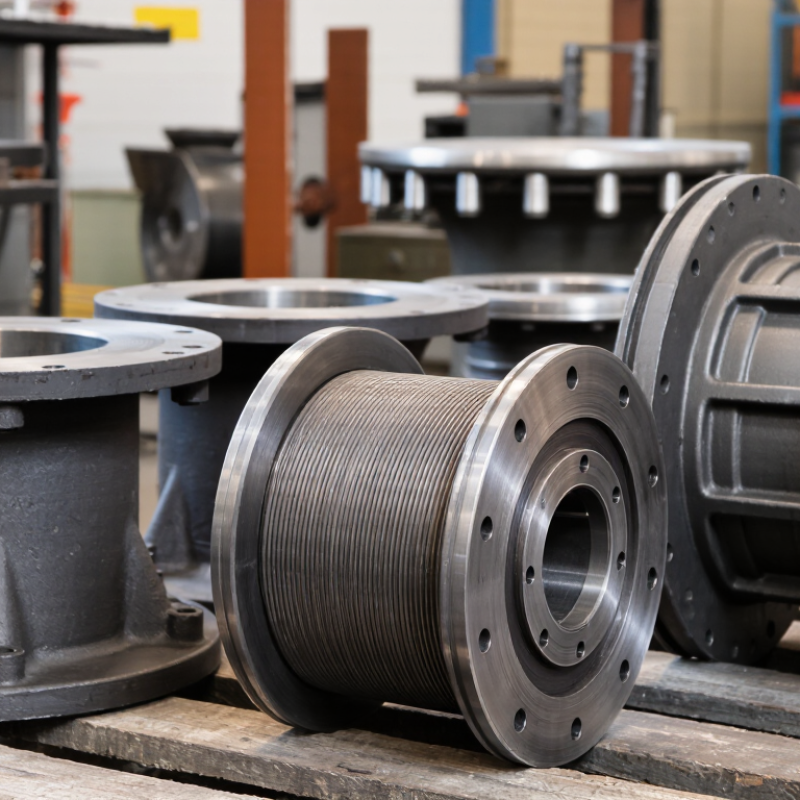
Cast iron drums are cylindrical components built for stability, heat control, and repeated mechanical loads. Their structure usually includes a shell, central bore, hub, and reinforcing ribs. Some designs use mounting flanges or machined grooves. Gray cast iron offers good vibration damping and economical production. Ductile iron provides higher strength and better impact resistance. Material choice depends on load, speed, temperature, and operating environment.
Common types include brake drums, winch drums, cable drums, and processing drums. Brake drums dissipate friction heat through thick walls and external fins. Winch drums use grooved surfaces to guide wire rope evenly. Cable drums may include wide flanges and reinforced hubs for controlled winding. Processing drums often require smoother surfaces and corrosion-resistant protection. In practice, names can overlap. This is easy to overlook.
Tips: Confirm the bore, flange dimensions, groove profile, balancing grade, and casting standard before purchasing. Ask for hardness data, dimensional inspection records, and surface-finish requirements. Check whether machining is included. A rough casting may look acceptable but perform poorly after installation. Consider transport weight, packaging strength, and local testing expectations. Small dimensional errors matter.
2026 Top Cast Iron Drum Types for Global Buyers
Key Cast Iron Drum Types and Their Distinguishing Features
Cast iron drums vary by use, load, and mounting design. Brake drums use internal friction surfaces and cooling ribs to manage repeated heat. Their key checks include wall thickness, balance, bore accuracy, and resistance to cracking. Cable drums and winch drums usually feature wider flanges and reinforced hubs. These parts guide cables evenly and support steady torque. Some industrial drums use machined faces for tighter alignment. Surface finish matters.
Buyers should also compare standard cast iron with ductile iron. Standard cast iron offers good wear resistance and vibration damping. Ductile iron provides greater toughness under impact and bending forces. The better choice depends on load cycles, temperature, and installation conditions. A heavy drum is not always stronger. Poor machining can create imbalance, noise, or premature wear. I would not judge quality from appearance alone. Internal defects may remain hidden without suitable inspection.
Tips: Request drawings, material grades, hardness data, and dimensional reports before ordering. Confirm the bore, keyway, flange diameter, and operating speed. Ask how the supplier checks cracks and balance. Measure before ordering. Test samples under realistic conditions when possible. Requirements can differ between regions, so verify applicable transport, workplace, and product standards with a qualified local professional.
Key cast iron drum material types and their distinguishing features
How to read the chart: The values show representative midpoint tensile-strength levels in commonly specified ASTM grade families. Ductile iron generally provides the highest strength and impact resistance, while gray iron offers excellent damping and castability.
Reference basis: representative midpoint values from commonly specified ASTM A48 gray iron, ASTM A536 ductile iron, ASTM A47 malleable iron, and ASTM A842 compacted graphite iron grade families. Actual performance depends on grade, casting design, heat treatment, and service conditions.
When comparing cast iron drum types, start with usable capacity, not the advertised volume. A drum marked at 500 liters may hold less after liners, paddles, or safety clearance. Measure the working volume and maximum load separately. Dense materials can overload the shell before the space is full. That distinction matters.
In field inspections, I check wall thickness, joint quality, and the drum’s center of gravity. A balanced drum rotates more smoothly and places less stress on bearings. Ask for load-test records, material certificates, and dimensional drawings. These documents make supplier claims easier to verify. Small details matter. A practical trial with your material remains valuable, because flow behavior can change sharply with moisture or particle size.
Finish affects cleaning, corrosion resistance, and service life. A smooth internal surface reduces trapped residue, while an external protective coating helps limit surface rust during ocean transport. However, a glossy finish does not prove strong performance. Inspect corners, drain areas, and lifting points closely. Rough patches often appear there first. For demanding cycles, compare rotation speed, torque requirements, heat tolerance, and noise levels under load. Cast iron offers excellent rigidity and wear resistance, but it is heavy and less forgiving when mishandled. I once underestimated handling space around a loaded drum; the equipment worked, but installation became unnecessarily difficult. Buyers should review maintenance access, replacement parts, and operating conditions before choosing capacity or finish.
For global buyers, cast iron drums should be evaluated against function, not appearance. A heavy wall does not guarantee safe transport. Cast iron can resist compression, yet sudden impact may cause cracking. Inspectors should examine casting porosity, lid seating, gasket condition, and corrosion around the base. Capacity markings must match the tested design. A nominal 200-liter drum is not automatically certified for every cargo.
For regulated substances, the UN Recommendations on the Transport of Dangerous Goods require design-type testing. Tests may include drop impact, stacking, leakproofness, and hydraulic pressure, depending on the contents. UNECE ADR 2025 applies similar performance principles for road transport. The UN Manual of Tests and Criteria, eighth revised edition, should guide test selection. Certification should identify the packaging code, test report, closure method, and permitted packing group. Paperwork matters.
The ISO Survey 2023 recorded more than 1.26 million ISO 9001 certificates worldwide. This figure shows the scale of quality management, but ISO 9001 alone does not certify a drum. Buyers should request material records, dimensional inspection results, and traceable batch numbers. Check lifting points, internal coatings, and temperature limits before purchase. Some suppliers provide attractive certificates with weak test evidence. That deserves scrutiny. A practical factory audit remains imperfect, but it can reveal loose covers, uneven castings, and missing inspection logs before shipment.
Important scope note: Conventional UN-certified industrial drums are generally manufactured from carbon steel or stainless steel rather than cast iron. Cast-iron drums are typically selected for specialized, high-mass, heat-resistant, or mechanical-duty applications. Any drum intended for regulated transport must be tested and certified as a complete packaging design; material selection alone does not establish UN approval.
| Drum Type | Typical Nominal Capacity | Typical Configuration | Indicative Dimensions | Common Applications | Main Safety Considerations | Relevant Global Standards | Certification Considerations |
|---|---|---|---|---|---|---|---|
| Tight-Head Cast-Iron Drum | 60–220 L | Permanent closed top with threaded or flanged filling and discharge openings | Approx. 380–610 mm diameter; 600–950 mm height, depending on capacity and wall design | Non-pressurized solids, mineral products, foundry materials, and selected industrial powders | Check closure torque, gasket compatibility, corrosion, lifting points, and pressure limitations. Do not use as a pressure vessel. | UN Model Regulations; ISO 15750 where applicable to steel drum design; ADR, IMDG Code, or applicable national transport rules | A UN mark requires successful design-type testing, including leakproofness, hydrostatic pressure where applicable, stacking, lifting, drop, and permeability tests. |
| Open-Head Cast-Iron Drum | 30–220 L | Removable cover secured with a bolted or lever-locking closure ring | Approx. 300–610 mm diameter; 400–950 mm height | Viscous materials, granules, maintenance compounds, and materials requiring wide-mouth access | Inspect cover seating, closure-ring condition, gasket compression, sharp edges, and safe manual-handling limits. | UN Model Regulations; ADR; IMDG Code; IATA DGR for air shipments when the packaging design is approved for the substance | The closure system is part of the tested design. Changing the cover, gasket, ring, or internal lining may invalidate the original approval. |
| Ribbed Heavy-Duty Drum | 60–220 L | Circumferential reinforcing ribs with either a closed or removable top | Approx. 380–610 mm diameter; 600–950 mm height; rib profile varies by design | Outdoor storage, abrasive solids, heavy industrial components, and applications requiring improved side-wall stiffness | Ribs improve rigidity but do not automatically increase allowable stacking load. Verify pallet stability and forklift handling. | ISO 15750 principles for industrial drums where applicable; UN packaging performance requirements; regional workplace-handling rules | Stacking height, load rating, and transport classification must be supported by test evidence for the exact design and closure configuration. |
| Lined Cast-Iron Drum | 30–220 L | Cast-iron body with an internal coating or liner selected for chemical compatibility | Usually based on 30, 60, 120, or 210/220 L drum formats | Corrosive or reactive contents where the lining provides the primary compatibility barrier | Confirm resistance to the specific chemical, concentration, temperature, and storage time. Inspect for pinholes, blistering, cracking, and liner adhesion failure. | UN Model Regulations; ADR; IMDG Code; applicable chemical-compatibility and workplace-safety requirements | The lining, coating process, closure, and contents must be evaluated together. A food-contact or chemical-resistance claim requires supporting test documentation. |
| Heat-Resistant Industrial Drum | 20–220 L | Thick-walled body, heat-resistant coating, or thermal shielding; configuration varies by process | Dimensions are application-specific; common sizes follow 60–220 L industrial drum formats | Hot-process residues, thermal-treatment operations, ash, slag-related materials, and high-temperature handling areas | Define maximum service temperature, thermal cycling, cooling procedure, ventilation, and burn protection. Never seal hot contents unless designed and approved for it. | Applicable occupational safety rules; UN/ADR/IMDG requirements if used for regulated transport after cooling | Temperature capability is not normally established by a transport-package mark alone. Obtain engineering test data for thermal exposure and closure performance. |
| Salvage Drum with Cast-Iron Construction | Typically 110–220 L internal volume | Oversized, reinforced container used to enclose a damaged or leaking inner package | Sized to provide clearance around the inner package; exact dimensions depend on the damaged package | Emergency containment and transport of damaged, defective, or leaking packages | Use compatible absorbent or cushioning material where required. Secure the inner package and prevent movement during handling and transport. | UN Model Regulations; ADR; IMDG Code; applicable national dangerous-goods rules | Salvage-packaging requirements are substance- and route-dependent. Confirm permitted size, marking, labeling, and documentation before shipment. |
| Non-UN Storage and Process Drum | 10–500 L | Open or closed container designed for internal storage, batching, or process use | Custom dimensions; capacity and wall thickness are selected for the process | Factory storage, workshop use, non-regulated waste, and material staging | Assess stability, grounding, ventilation, chemical compatibility, manual-handling risk, and secondary containment requirements. | Local occupational safety, fire prevention, waste-management, and environmental regulations | Do not apply a UN mark unless the exact packaging has completed the applicable performance tests and has valid approval documentation. |
| Verification Item | What Buyers Should Confirm |
|---|---|
| Material and construction | Cast-iron grade or specification, wall thickness, closure material, gasket material, coating or liner, welds or cast features, and corrosion allowance. |
| Capacity and dimensions | Nominal capacity, working capacity, tare mass, gross mass, outside dimensions, internal dimensions, pallet footprint, and center of gravity. |
| Dangerous-goods suitability | UN packaging code, packing group, approved contents, closure instructions, test report, certificate validity, and permitted transport modes. |
| Transport route | Whether the shipment moves by road, sea, air, rail, or multimodal transport, and which rules apply in the origin, transit, and destination countries. |
| Safety documentation | Safety data sheet, chemical compatibility statement, handling instructions, inspection procedure, lifting limits, and emergency-response information. |
| Inspection and maintenance | Incoming inspection, periodic closure checks, corrosion monitoring, liner inspection, damage criteria, cleaning method, and reuse limitations. |
Selecting the right cast iron drum starts with load, environment, and local standards. Grey cast iron suits brake drums and low-impact machinery because it dampens vibration well. Ductile iron offers higher tensile strength for lifting, rotating, or shock-loaded equipment. Coated drums perform better near saltwater, humidity, and chemical exposure, but coatings can hide casting defects.
The World Foundry Organization’s 2024 production data reported global castings output at roughly 109 million tonnes in 2023. This scale shows strong manufacturing capacity, yet quality varies between foundries. ASTM A48 supports grey iron specifications, while ASTM A536 covers ductile iron. European buyers may request EN 1561 or EN 1563 documentation. Always confirm wall thickness, hardness, balancing, and traceability before shipment. Small variations can create serious vibration problems.
Tips: Match the drum to its working temperature and impact level. Request chemical analysis, mechanical test results, and dimensional inspection records. For coastal markets, ask for salt-spray or corrosion testing. For heavy machinery, verify fatigue performance instead of relying only on static strength. A cheaper drum may fail earlier. That is easy to overlook. Also, do not assume one grade fits every country. Local standards, repair habits, and climate can change the practical choice. Procurement teams should review real operating data, although many projects still depend on incomplete field feedback.